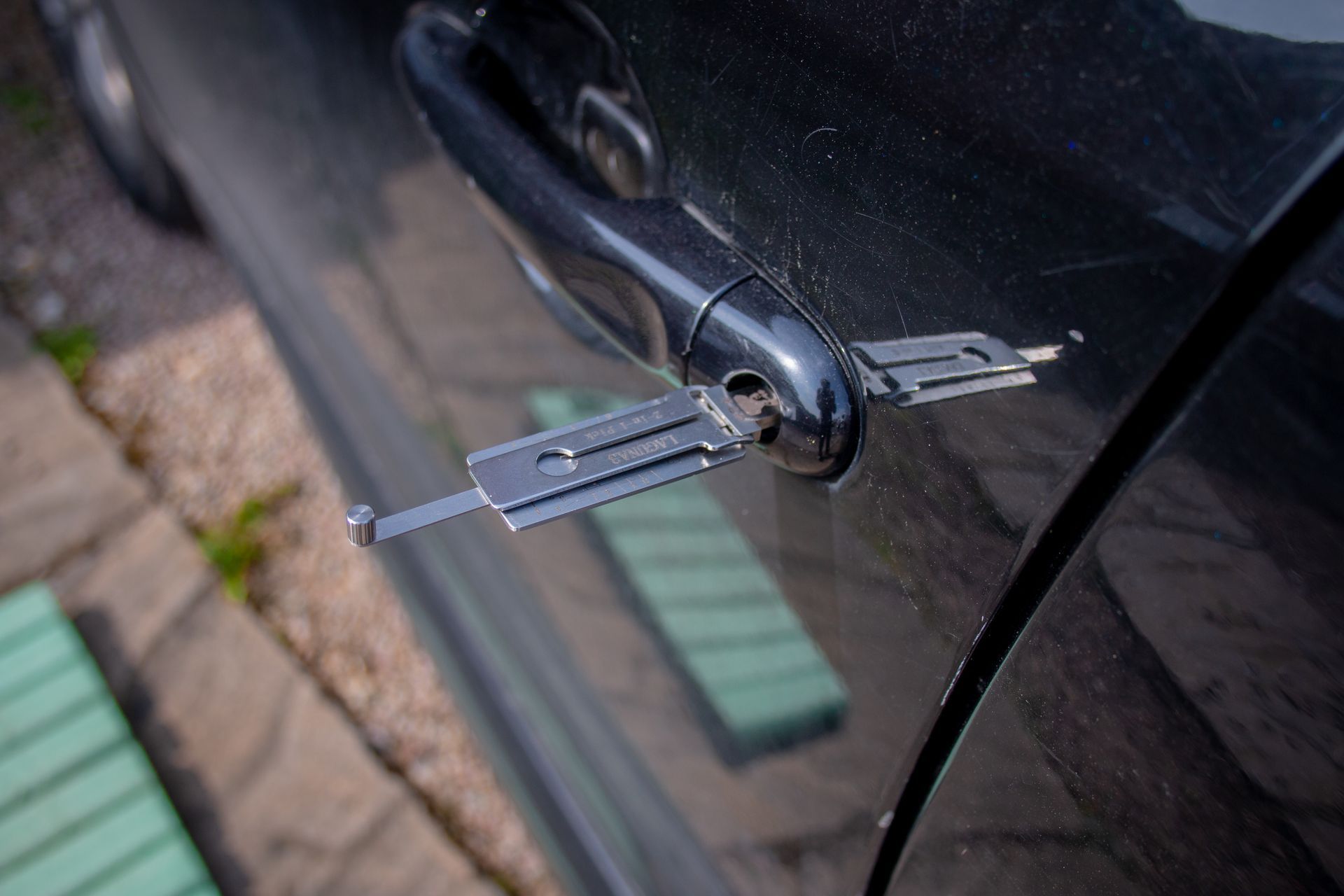
Locked keys inside a car happen to careful people just as often as anyone else — a habit of pressing the lock button on the way out, a toddler who hit the switch from a booster seat, a fob that died in a coat pocket on the seat instead of your hand. Whatever the reason, Liberty Locksmith sends a technician to wherever your car actually is, with the tools to get the door open without adding a second problem to the first.
When You Need Car Lockout Help
The obvious case is keys visible on the seat and a door that won’t budge, but we get called for plenty of variations on that theme. Key fobs go dead at the worst moment and leave a car that looks unlocked on the display but isn’t. Cars parked inside an attached garage lock people out just as thoroughly as one parked on the street — we come into the garage the same way we’d work a driveway. And trunk lockouts happen on their own: keys inside a trunk after loading groceries, hockey gear, or a stroller, with the cabin locked separately.
One situation gets handled differently: if a child or a pet is locked inside a car, especially in summer heat or winter cold, call 911 first. Emergency responders can act faster than a scheduled service call and are equipped for exactly that risk. We’re glad to roll at the same time, but the first call in that situation should always be to 911, not to us.
How We Get You Back In
Every car lockout starts with a quick look at the vehicle — make, model, and whether it’s an older mechanical lock or a newer system tied into the central locking and alarm. From there we use inflatable wedges and slim reach tools to work the gap at the top corner of the door, angling a rod to trip the interior handle or unlock button without scratching paint or bending the frame. For lock cylinders themselves, particularly on older vehicles or when the cylinder is the only way in, we use Lishi-style pick tools cut to that manufacturer’s keyway.
What we don’t do is slim-jim a modern car. That flat-bar method was built for a generation of vehicles with simple mechanical linkages, and on anything built in the last fifteen-plus years it risks the wiring harness, the side-curtain airbag sensor, or the door module wedged right where the tool needs to go. A locksmith who reaches for a slim jim on a current-model car is trading a faster job for a much more expensive mistake. Most lockouts run 10 to 20 minutes once the technician is on scene; a stubborn lock or an unusual vehicle can take longer.
Trunk Lockouts
A trunk locked separately from the cabin is its own kind of frustrating, especially with a full trunk and no idea where the keys ended up. On most vehicles the trunk can be reached from inside the car — through a fold-down rear seat or a trunk-release lever near the driver’s seat — so opening the cabin door often solves the trunk problem too. When a car doesn’t have that pass-through, or the trunk is the only compartment that’s locked, we work the trunk’s own lock cylinder with the same non-destructive tools, rather than forcing the lid or drilling anything out.
Locked Out in Minnesota Winter
Cold makes ordinary lockouts worse. Freezing rain and refreeze cycles can lock a door mechanism solid even when the key is in hand, and a key that goes into a frozen cylinder but won’t turn is functionally the same lockout as one where the keys are inside. We carry de-icer and warm the cylinder rather than forcing a key that could snap in the cold — a broken key in a frozen lock turns a fifteen-minute call into a much longer one. If your lock has frozen shut with the keys nowhere near it, treat it as a lockout call and we’ll bring what it takes to open it without cracking anything.
What Affects Response Time — and What Affects Cost
Response time and cost come down to a lot of the same factors. Vehicle and lock type is one: some manufacturers build security systems into the car that take a technician an extra step or two beyond a straightforward wedge-and-rod entry, and that extra step is what moves the price — not a flat rate charged to every car regardless of what’s involved. Where you are in the metro relative to the technician on call is another factor that cuts both ways, shaping how soon we can get there and how the call is priced. Time of day plays in too; an overnight or holiday call carries a different rate than a weekday afternoon call in Minneapolis, the same way it would with any trade that runs 24/7.
None of that gets estimated over the phone and quietly changed once a technician is standing at your car. Dispatch walks through your situation — vehicle, location, time — and gives you an honest arrival window. Before any tool touches your car, you get the price for the job, not a guess that moves once the work has started.
Wherever you’re stuck — driveway, ramp, or roadside — call and a technician heads your way with everything needed to open the car without damage. See the full list of cities we cover across the Twin Cities metro.
We handle all of this on-site across the metro — see our service areas.
Frequently Asked Questions
Will unlocking my car damage the door or lock?
No. We use inflatable wedges and slim reach tools designed for the gap between the door and frame, plus lock-pick tools built for the exact cylinder in your car. Nothing goes through the window, and nothing pries the door panel. If a technician ever finds a vehicle that can't be opened cleanly with the right tool, we'll say so before trying anything riskier.
How fast can you reach me?
We're mobile and dispatch out of Minneapolis around the clock, so there's no fixed number that fits every call. When you call, dispatch works out your arrival window right then, based on where you are in the metro and what's happening on the roads and in the weather at that hour. You'll have that window before a technician ever heads your way.
What do I need to show when you arrive?
Something that shows the car is yours or that you're authorized to be in it — a driver's license matched against the registration, a key fob, an insurance card, or a lease/rental agreement. We ask every time, even if you're clearly standing next to your own car, because that check protects you as much as it protects us.
Can you open a trunk without keys?
In most cases, yes. Many trunks release from inside the cabin through a fold-down rear seat or a trunk-release lever, so once the cabin is open we can often reach the trunk without ever touching the trunk lock. On vehicles without that pass-through, we work the trunk lock cylinder directly with the same non-destructive tools used on the doors.